Erik Hayes · 11 November 2026
Fossilized Baltic Resin Offers Clues to Ancient Climate Patterns in European Forests
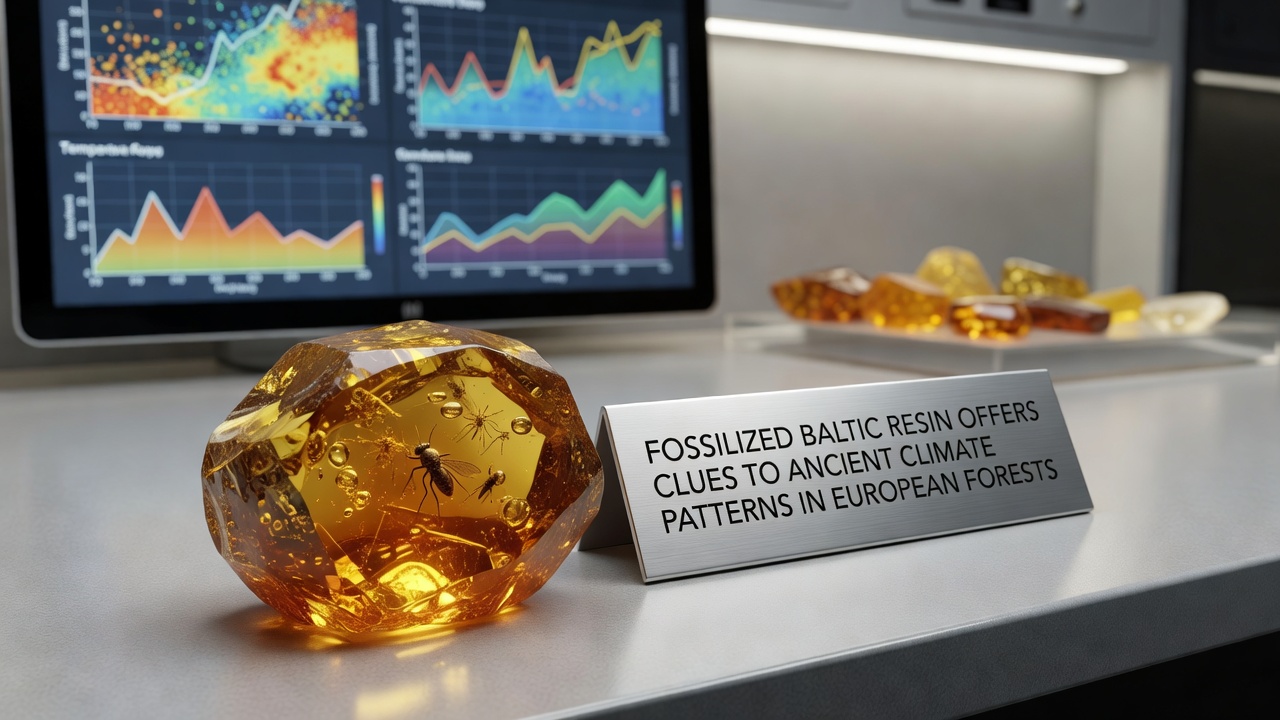
Baltic amber, formed from resin exuded by coniferous trees during the Eocene epoch roughly 44 to 48 million years ago, continues to yield detailed records of past European forest ecosystems and the climate conditions that shaped them. Researchers extract these records through analysis of trapped insects, pollen grains, and chemical signatures preserved within the hardened resin, while cross-referencing the data with geological strata from sites across Poland, Lithuania, and northern Germany.
Scientists measure stable isotopes of carbon and oxygen in the resin matrix itself, and these ratios shift in patterns that align with temperature fluctuations and precipitation levels during the period when the forests thrived under warmer, more humid conditions than those seen in modern temperate Europe. Data from multiple amber deposits indicate average temperatures 10 to 15 degrees Celsius higher than present-day values in the same latitudes, with seasonal rainfall supporting dense mixed woodlands dominated by pines, oaks, and early flowering plants.
Preservation Mechanisms and Analytical Techniques
Resin flows captured air bubbles, volatile organic compounds, and biological material before polymerization sealed them away, and laboratories now employ gas chromatography-mass spectrometry along with synchrotron imaging to identify species-specific biomarkers without damaging the specimens. One study revealed that certain terpenoid profiles in the amber matched those of modern Araucariaceae and Pinaceae families, allowing reconstruction of forest composition across what is now the Baltic Sea basin.
Pollen inclusions show shifts from subtropical elements toward more temperate assemblages as the Eocene progressed, and these transitions coincide with global cooling episodes documented in deep-sea sediment cores. Observers note that the spatial distribution of amber-bearing sediments suggests the original forests extended over several hundred kilometers inland from the ancient coastline, creating a continuous habitat that supported diverse arthropod communities now frozen in time.
Recent Fieldwork and Upcoming Presentations
Excavations conducted in 2024 and 2025 at the Sambia Peninsula and adjacent Latvian sites recovered fresh amber layers containing exceptionally preserved leaf fragments and bark, while micro-CT scans revealed internal structures of scale insects and mites that lived in the canopy. These finds add resolution to existing climate models by confirming the presence of episodic drought stress, visible in growth rings preserved within associated wood fragments.
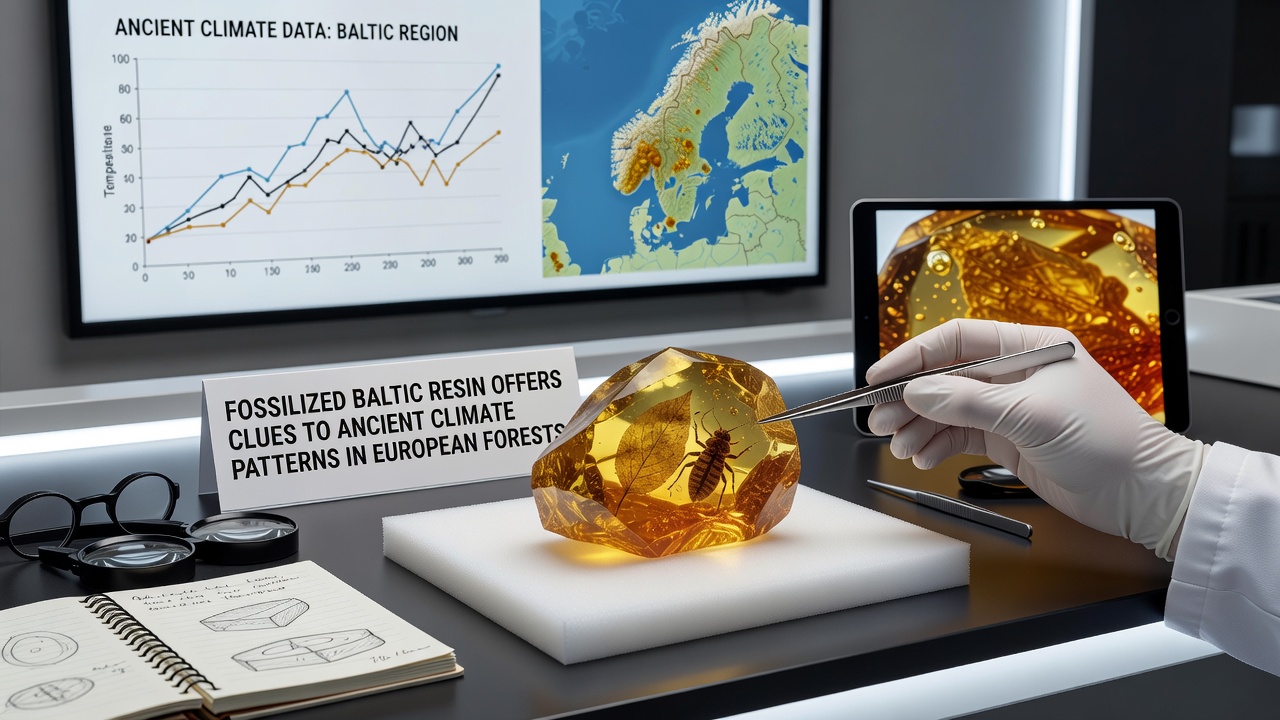
In November 2026, teams from several European institutions plan to present integrated datasets at an international paleoclimate symposium, combining amber chemistry with leaf stomatal density counts and biomarker lipids from the same horizons. Such coordinated efforts allow direct comparison between resin-derived temperature estimates and those obtained from nearby marine records.
Connections to Broader European Paleoenvironments
Amber deposits also appear in Ukraine and Belarus, and comparative studies demonstrate that resin production peaked during intervals of elevated atmospheric carbon dioxide, consistent with greenhouse conditions reconstructed from European Environment Agency paleoclimate archives. The resulting forest canopy likely moderated local microclimates, fostering high humidity levels that favored resin exudation as a defense against herbivorous insects and fungal pathogens.
Trace element analysis further shows elevated sulfur and nitrogen compounds during certain stratigraphic intervals, suggesting volcanic activity or wildfires influenced atmospheric chemistry and, by extension, forest stress responses recorded in the resin chemistry. These geochemical markers align with ash layers identified in coeval sedimentary basins across northern Europe.
Integration with Modern Climate Research
Climate scientists incorporate amber-derived temperature and precipitation reconstructions into Earth system models to test the sensitivity of mid-latitude forests to rapid warming, and the Eocene examples provide a natural experiment for conditions expected under continued anthropogenic carbon emissions. NOAA climate education resources highlight how such deep-time analogs improve projections of ecosystem resilience in contemporary European woodlands.
Researchers continue to refine dating methods using fission-track analysis on zircon grains within the amber-bearing sediments, tightening the temporal framework so that individual climate events can be placed within orbital cycles of 100,000 years or less. This precision supports finer-scale correlation with global marine isotope stages.
Conclusion
Baltic amber therefore functions as both an archive and a calibration tool for understanding how European forests responded to past climate shifts, with ongoing laboratory and field programs scheduled through late 2026 expected to deliver additional quantitative datasets. The preserved biological and chemical evidence offers a direct window into forest dynamics that operated under atmospheric compositions and temperature regimes different from those of the present, informing both paleontological reconstruction and forward-looking ecological modeling.